Yoga AI Tools 瑜伽 AI 工具組

I built two AI tools for yoga teachers. Then I discovered the real problem wasn't about tools at all. It was about the gap between finishing teacher training and actually standing in front of a class. 我為瑜伽老師做了兩個 AI 工具。然後發現真正的問題根本不是工具,而是師培結業到真正站上去教課之間的那段空白。

Personal project 個人專案 2025 – present Builder + target user 開發者+目標用戶

The Problem Behind the Tools 工具背後的問題

I built these tools to practice teaching. But using my own product, I realized they solved technique while the real blockers went untouched: identity, confidence, and the social cost of asking people to show up. 我做這些工具是為了練習教課。但用自己的產品後發現,它們解決了技術問題,真正的障礙卻沒碰到:身份認同、信心,以及開口邀人來上課的社交成本。

Post-YTT struggles aren't different problems for different people. They're the same person at three moments: 師培後的困境不是不同人的不同問題,而是同一個人在三個不同時刻:

Moment階段 Feeling感受 What They Need需要的
1. "Am I a teacher?"1.「我算老師嗎?」 Identity limbo after YTT師培後的身份空白 Validation, a mirror肯定、一面鏡子
2. "How do I start?"2.「我怎麼開始?」 Can teach but can't get going會教但跨不出去 Lower barriers, invitations降低門檻、邀請機制
3. "What now?"3.「然後呢?」Cut捨棄 Teaching but no career path在教但沒有職涯路徑 Different persona, different product不同的人物、不同的產品

I focused on Moments 1 and 2. Moment 3 serves a different persona with different needs. Trying to solve all three would dilute the product. 我聚焦在第 1 和第 2 階段。第 3 階段服務的是不同人物、不同需求。三個都想解決只會稀釋產品。


Teacher Side 師培端

Cue

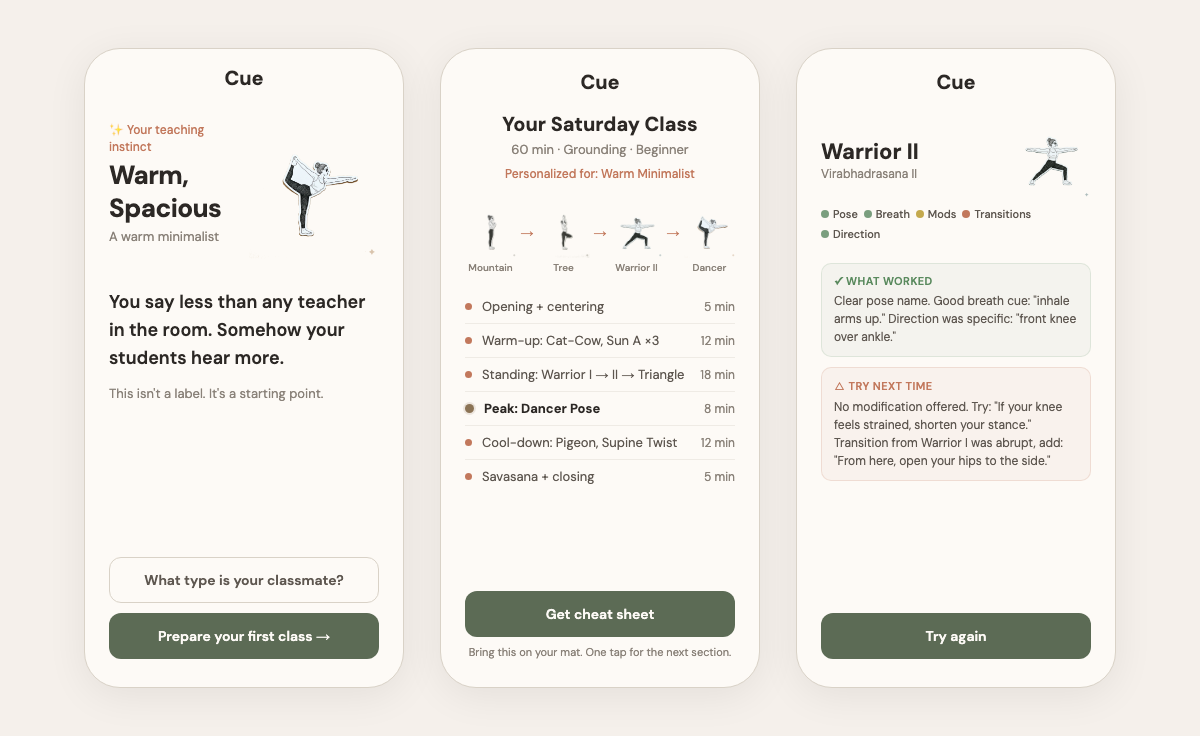
After YTT, the gap between knowing poses and teaching a class has too many steps. This tool compresses them: discover your teaching style, generate a class plan in 15 minutes, and practice your verbal cues with AI feedback across five dimensions. 師培結業後,從「我會體式」到「我可以教一堂課」中間有太多步驟。這個工具壓縮它們:探索你的教學風格、15 分鐘生成課程計畫、用 AI 回饋練習五個維度的口令引導。

Cue — teaching preparation tool for post-YTT yoga teachers

Next.js · Whisper · Claude Haiku · Vercel  |  136 poses · 2,600+ relationships · 18 sequences · 5 archetypes Next.js · Whisper · Claude Haiku · Vercel  |  136 個體式 · 2,600+ 個關係 · 18 個序列 · 5 種風格原型

Try It → 試用 →

Cue: Key Decisions Cue:關鍵決策

Style Discovery as Entry Point教學風格探索作為起點

— Most apps start with account setup. Cue starts with "what kind of teacher are you?" Three questions, no right answers. You learn something about yourself before the app asks anything of you. — 多數 app 從帳號設定開始。Cue 從「你是什麼樣的老師?」開始。三個問題,沒有標準答案。在 app 要求你任何事之前,你先認識了自己。

Top-Down, Not Bottom-Up由上而下,不是由下而上

— Traditional approach: master poses, then sequences, then a full class. Cue flips it: start from "I'm teaching Saturday," work backwards to what you need. Preparation on demand, not curriculum. — 傳統方式:先學體式、再學序列、最後整堂課。Cue 反過來:從「我週六要教課」開始,往回推你需要什麼。按需準備,不是課程表。

Cheat Sheet Over Memorization小抄取代背誦

— The goal isn't to memorize a 60-minute class. It's to feel ready enough to teach one. A phone-friendly cheat sheet during class removes the fear of forgetting what comes next. — 目標不是背下 60 分鐘的課。而是讓你覺得準備好了。上課時手機上的小抄,消除「忘記下一步」的恐懼。

Student Side 學生端

Yoga Notes

A 75-minute class recording sits in your phone. You never revisit it. The teacher's cues fade within a week. 75 分鐘的課堂錄音躺在手機裡,你不會回去聽。老師的引導一週內就忘了。

This tool turns that recording into structured notes (synced to Notion), a 10-minute follow-along practice guide, shareable content cards, and auto-edited reels. 這個工具把錄音變成:同步到 Notion 的結構化筆記、10 分鐘跟練音檔、可分享的內容卡片、自動剪輯的短影片。

Example content card output showing a hatha flow sequence

Python · FastAPI · Whisper · Gemini · Notion API · Cloud Run Python · FastAPI · Whisper · Gemini · Notion API · Cloud Run

Try yoga.notes → 試用 yoga.notes →

Yoga Notes: Key Decisions Yoga Notes:關鍵決策

Four Outputs, One Recording一段錄音,四種產出

— One 75-minute recording serves four different moments in a student's week: notes for review, a 10-minute audio guide for home practice, content cards for sharing, and reels for social. Students don't need one better format, they need the right format for each context. — 一段 75 分鐘的錄音服務學生一週裡的四個不同時刻:筆記用來複習、10 分鐘音檔用來在家跟練、內容卡片用來分享、短影片用來社群。學生不需要一個更好的格式,而是每個情境都有對的格式。

Cards Over Documents卡片取代文件

— Students share specific poses with friends, not full class notes. Designing for sharing (discrete cards) instead of archiving (long documents) changed what the product is: not a note-taking app, but a content engine for yoga students. — 學生跟朋友分享的是特定體式,不是完整課堂筆記。為分享(獨立卡片)而非存檔(長文件)設計,改變了產品的本質:不是筆記 app,而是瑜伽學生的內容引擎。

Practice Guide as the Real Product練習指南才是真正的產品

— The notes were the obvious output. But watching how I used my own tool, the 10-minute follow-along practice guide got more use than the notes. The recording is the input. The practice is the product. Notes are a side effect. — 筆記是最直覺的產出。但觀察自己怎麼用這個工具後發現,10 分鐘跟練指南的使用率比筆記高。錄音是輸入,練習才是產品,筆記只是副產品。
What Building Both Taught Me 做這兩個工具教會我的事

Same domain, two tools, one lesson: the interesting product decisions aren't technical. They're about judgment. When to automate, when to leave room for the human. When to ship with a disclaimer instead of chasing perfection. 同一個領域、兩個工具、一個教訓:有趣的產品決策不是技術問題,而是判斷。什麼時候該自動化、什麼時候該留空間給人。什麼時候帶著免責聲明上線,而不是追求完美。

Being both builder and user meant I could feel when something was off before articulating why. I designed a "30-Day Teaching Challenge," then killed it because it demands identity commitment from someone who hasn't decided they're a teacher yet. That instinct, feeling what the user would feel before they tell you, is the same loop that made products better at Dcard: build, use, notice the gap, rebuild. 同時身為開發者和使用者,讓我能在說出原因前就感覺到哪裡不對。我設計了「30 天教學挑戰」,然後砍了,因為它要求一個還沒決定自己是老師的人做出身份承諾。這個直覺,在使用者告訴你之前就感受到他們的感覺,跟在 Dcard 做產品時一模一樣的迴圈:做、用、發現落差、重做。

Questions about these projects or how I think about product? 對這些專案或我的產品思維有任何問題?

Get in Touch 聯繫我 Back to Portfolio 回到作品集